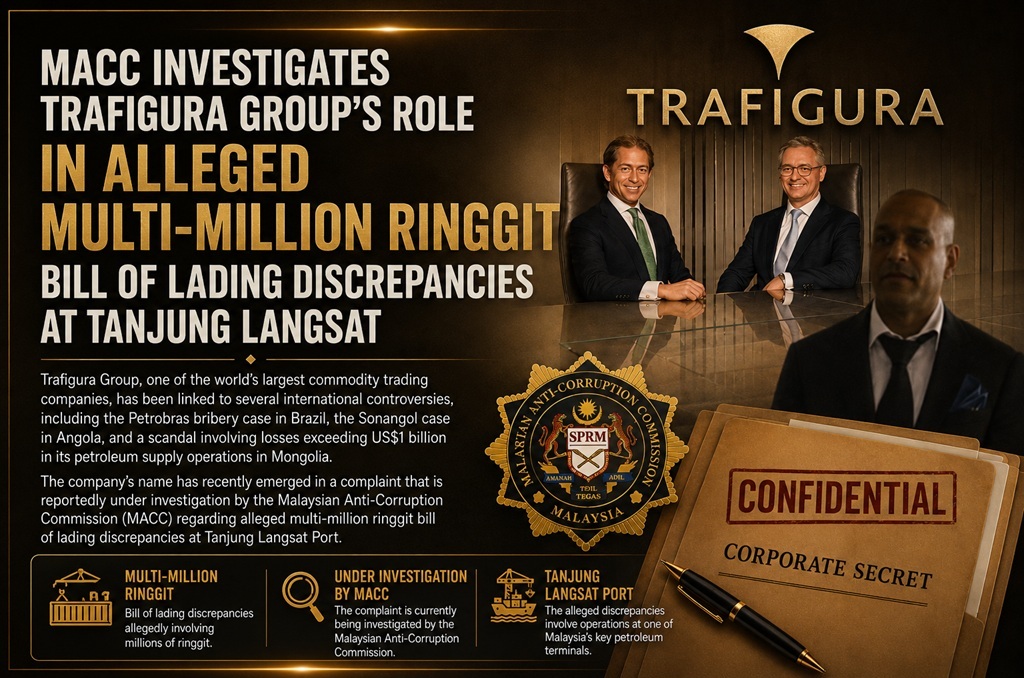
The Malaysian Anti-Corruption Commission (MACC) has been urged to conduct a comprehensive investigation into allegations involving discrepancies between Bill of Lading (BL) documentation and the actual physical movement of petroleum cargoes within the supply chain at Tanjung Langsat Port, Johor, including any transactions linked to Trafigura Group Pte. Ltd.
According to sources, the ongoing inquiry focuses on claims that shipping documents did not correspond with the actual handling and movement of petroleum cargoes in transactions reportedly worth millions of ringgit. Complaints submitted to MACC are also said to involve transactions connected to Trafigura Group Pte. Ltd., a Singapore-based multinational commodities trading company and one of the world’s largest independent traders of oil and raw materials.
Sources further revealed that Datuk Seri Jeyenderan Ramasamy, Chief Executive Officer of Maritime Network Sdn Bhd, met MACC officers in Putrajaya in early May to provide information relating to the allegations. However, to date, no raids, arrests, remand orders, or criminal charges have been announced against any individual or company, and investigations remain ongoing.

The case has emerged amid growing global concern within the maritime and commodities trading industries over risks arising from inconsistencies between shipping documentation and the actual location or movement of cargoes, particularly in petroleum transactions involving multiple parties across complex supply chains.
On 13 May, Jeyenderan warned that discrepancies between Bills of Lading and the physical movement of cargoes have become one of the most significant operational and compliance risks facing the international shipping and commodities trading sectors.
According to him, a Bill of Lading is far more than a routine shipping document. It serves as the foundation for banking transactions, insurance coverage, customs declarations, proof of cargo ownership, and compliance with international trade sanctions.
“The greatest risk to shipping agents arises when the physical movement of cargo no longer matches the accompanying documentation. Any mismatch between operational handling and documentary records can expose all parties in the supply chain to significant legal, financial, and compliance risks,” he said.
He further explained that the challenge becomes particularly complex in oil trading, where shipping agents often receive instructions from multiple parties, including commodity traders, cargo receivers, terminal operators, forwarding agents, and logistics providers, whose directions may not necessarily align with the original Bill of Lading.
Industry practices such as oil blending and commingling after cargo discharge are common. However, traceability becomes increasingly difficult once products enter storage systems and are mixed with existing inventories.
Jeyenderan noted that when customs records, Bills of Lading, tank measurements, and the actual location of cargoes cease to correspond, the industry risks losing transparency over petroleum movements. Such situations can create compliance gaps, trigger commercial disputes, and potentially contribute to revenue leakages affecting national taxation and regulatory systems.
Several industry observers have called for a coordinated investigation involving MACC, the Royal Malaysian Customs Department (JKDM), the Inland Revenue Board (LHDN), Bank Negara Malaysia, the Malaysian Border Control and Protection Agency (AKPS), and the Royal Malaysia Police (PDRM) under a Multi-Agency Task Force (MATF) framework to address potential revenue leakages, corruption risks, and organised syndicate activities linked to petroleum trading operations.
Who Is Trafigura Group?
Trafigura Group is one of the world’s largest commodities trading firms, engaged in the trading of crude oil, petroleum products, natural gas, metals, and minerals. Founded in 1993, the company operates across dozens of countries through extensive networks in trading, logistics, marine transportation, storage, mining, and energy infrastructure.
Headquartered in Singapore, Trafigura maintains operations throughout Asia, Europe, the Middle East, Africa, and the Americas, employing more than 12,000 people worldwide. The company ranks among the largest independent traders in the global energy and commodities markets.
Since 1 January 2025, the company’s Chief Executive Officer has been Richard Holtum, who succeeded Jeremy Weir. Holtum previously led Trafigura’s Gas, Power and Renewables division.


International Enforcement Actions and Controversies
1. Petrobras Bribery Case – Guilty Plea in the United States
In March 2024, Trafigura pleaded guilty in a United States federal court to conspiracy charges involving violations of the Foreign Corrupt Practices Act (FCPA). The plea formed part of a settlement with the U.S. Department of Justice (DOJ) concerning allegations that the company paid bribes to officials at Brazil’s state-owned oil company, Petrobras.

According to court documents, prosecutors alleged that between 2003 and 2014, Trafigura used intermediaries, shell companies, and offshore accounts to channel payments to Petrobras officials in exchange for oil trading contracts. The company agreed to pay approximately US$127 million in penalties and forfeitures as part of the settlement.
2. Angola-Sonangol Bribery Conviction in Switzerland
In January 2025, Switzerland’s Federal Criminal Court found Trafigura and former Chief Operating Officer Mike Wainwright guilty in a bribery case involving contracts with Angola’s state oil company, Sonangol. Prosecutors alleged that more than US$5 million had been channelled through intermediaries to secure crude oil trading and shipping contracts.

The court ordered Trafigura to pay fines and compensation exceeding US$148 million, making it one of the most significant corporate corruption convictions in the history of the global commodities trading industry.
3. US$700 Million Nickel Fraud
In 2023, Trafigura disclosed that it had become the victim of one of the largest commodities frauds in modern trading history after shipments purportedly containing nickel were found to contain significantly lower-value materials. The case resulted in losses approaching US$700 million and led to extensive litigation before the High Court in London.
4. Mongolia Oil Trading Scandal
In October 2024, Trafigura announced that an internal investigation and independent forensic review had uncovered serious misconduct within its Mongolian petroleum operations. The company reported that manipulated data, falsified documentation, and concealed debts had resulted in losses of up to US$1.1 billion.

The incident became one of the largest financial losses in the company’s history and raised questions regarding internal controls, corporate governance, and risk management systems.
5. Probo Koala Toxic Waste Scandal
One of Trafigura’s most widely publicised controversies remains the Probo Koala toxic waste incident in Abidjan, Côte d’Ivoire, in 2006. Approximately 500 tonnes of waste linked to the chartered vessel were discharged and subsequently disposed of at multiple locations around the city. The incident generated international litigation and compensation claims, while Trafigura consistently denied direct responsibility for deaths or injuries alleged by certain claimants.

6. Indonesia’s US$17.6 Billion Pertamina Corruption Investigation
In July 2025, Indonesia’s Attorney General’s Office detained a Trafigura employee along with several other individuals as part of a major corruption investigation involving state-owned energy company PT Pertamina. The investigation concerns alleged irregularities in oil procurement, petroleum imports and exports, shipping arrangements, and compensation schemes between 2018 and 2023.

Trafigura Group’s Presence in Malaysia
Trafigura Group is one of the world’s largest commodity trading companies, with operations spanning petroleum, metals, minerals, and commodity logistics. In Malaysia, the company does not operate a retail fuel network like Petronas, Shell, or Petron. Instead, its presence is primarily focused on commodity trading, petroleum storage, logistics, and metals trading through a network of terminals and strategic partnerships with local industry players.
1. Tanjung Langsat Petroleum Terminal, Johor
One of Trafigura’s most significant investments linked to Malaysia was the development of a petroleum storage facility at Tanjung Langsat, Johor. On 25 September 2009, the first phase of the terminal commenced operations through a joint venture involving Puma Energy (then a subsidiary of Trafigura), MISC Berhad, and Dialog Group Berhad.

The first phase provided a storage capacity of 130,000 cubic metres and was designed to handle clean petroleum products such as naphtha, diesel, and aviation fuel. The second phase added a further 270,000 cubic metres of storage capacity for fuel oil, bringing the terminal’s total storage capacity to 400,000 cubic metres.
Tanjung Langsat’s proximity to Singapore made it a strategically important location for regional petroleum trading and storage activities. During the same period, Trafigura also owned and leased several other storage facilities in Johor and utilised floating storage facilities in Malaysian waters to support its global oil trading operations.
2. Masteel Signs RM500 Million Agreement with Trafigura in 2012
On 27 June 2012, Malaysia Steel Works (KL) Bhd (Masteel) announced the signing of a RM500 million offtake agreement with Trafigura Pte Ltd.
The three-year agreement covered the purchase and marketing of steel billets and steel bars produced by Masteel for both regional and international markets. The collaboration was viewed as a strategic move to expand Masteel’s access to Trafigura’s global trading network, which at the time was one of the largest commodity trading platforms in the world.

According to Masteel, the contract provided a degree of market assurance for part of the company’s production output while helping to improve operational efficiency and revenue stability. Trafigura, meanwhile, described Malaysia as one of the key markets within its Asian growth strategy.
The agreement was signed by Dato’ Sri Tai Hean Leng on behalf of Masteel and Dominic Watters on behalf of Trafigura. The signing ceremony was witnessed by the then Deputy Minister of International Trade and Industry, Datuk Jacob Dungau Sagan.
Who is Masteel and Dato’ Sri Tai Hean Leng?
Malaysia Steel Works (KL) Bhd (Masteel) is one of Malaysia’s leading steel manufacturers, principally involved in the production of steel billets and reinforcing steel bars used in the construction industry. The company is listed on the Main Market of Bursa Malaysia and operates major steel manufacturing facilities in the Klang Valley.
Dato’ Sri Tai Hean Leng is the Executive Vice Chairman and a substantial shareholder of Masteel. He has been closely associated with the company’s growth and expansion for decades and is widely regarded as one of the key figures in Malaysia’s steel industry. Under his leadership, Masteel pursued various strategic partnerships and international trading arrangements aimed at strengthening the company’s market position both domestically and abroad.


3. 2025: Trafigura Ships Nearly 100,000 Tonnes of Aluminium to Port Klang
Malaysia also plays an important role in Trafigura’s international metals trading network.
In November 2025, Reuters reported that Trafigura had delivered nearly 100,000 tonnes of aluminium to London Metal Exchange (LME)-registered warehouses located at Port Klang, Malaysia.
The shipment increased aluminium inventories at LME warehouses in Port Klang to 366,850 tonnes. According to industry sources cited by Reuters, a substantial portion of the aluminium was registered under LME warrants, enabling the metal to be traded through the international exchange’s metals trading system.

Reuters also reported that the transaction may have been linked to metals trading and financing strategies involving financial incentives and warehouse leasing arrangements, although Trafigura declined to comment on the matter.
The development highlights Port Klang’s continuing role as one of the key metal storage hubs within the global commodity trading network.
Malaysia as a Regional Trading Hub
Although Trafigura’s global headquarters is located in Singapore, Malaysia plays an important role in the company’s logistics and storage network across Southeast Asia.
From petroleum storage terminals in Tanjung Langsat to metals warehousing operations in Port Klang, Malaysia forms part of the infrastructure that supports Trafigura’s international energy and commodity trading activities.
International Controversies and Their Implications
In recent years, Trafigura has faced various enforcement actions and international controversies, including the Petrobras bribery case in Brazil, the Sonangol case in Angola, and a scandal involving losses exceeding US$1 billion linked to its petroleum supply operations in Mongolia.
Following the emergence of Trafigura’s name in a complaint reportedly being investigated by the Malaysian Anti-Corruption Commission (MACC) concerning allegations of multimillion-ringgit bill of lading discrepancies at Tanjung Langsat Port, several industry observers have argued that all parties named in the complaint should be subjected to a thorough investigation. Such a step is important to ensure transaction transparency, the integrity of trade documentation, compliance with customs regulations, and to rule out any possibility of manipulation within the petroleum supply chain.
Although there are currently no publicly known court convictions involving Trafigura in Malaysia similar to those seen in the Petrobras, Sonangol, or Mongolia cases, the company has been mentioned in various reports and complaints relating to petroleum trading and logistics activities due to its position as one of the world’s largest commodity and oil traders. The latest allegations concerning bill of lading discrepancies at Tanjung Langsat have also attracted considerable attention within the industry.
Given Malaysia’s strategic role in Trafigura’s regional petroleum and metals trading network, any allegations involving the company warrant serious attention from the relevant authorities. Where sufficient grounds and evidence exist, a comprehensive investigation by the MACC and the Malaysian Border Control and Protection Agency (AKPS) could help determine whether any violations of law, regulatory non-compliance, or supervisory weaknesses have occurred and whether further action is required.