
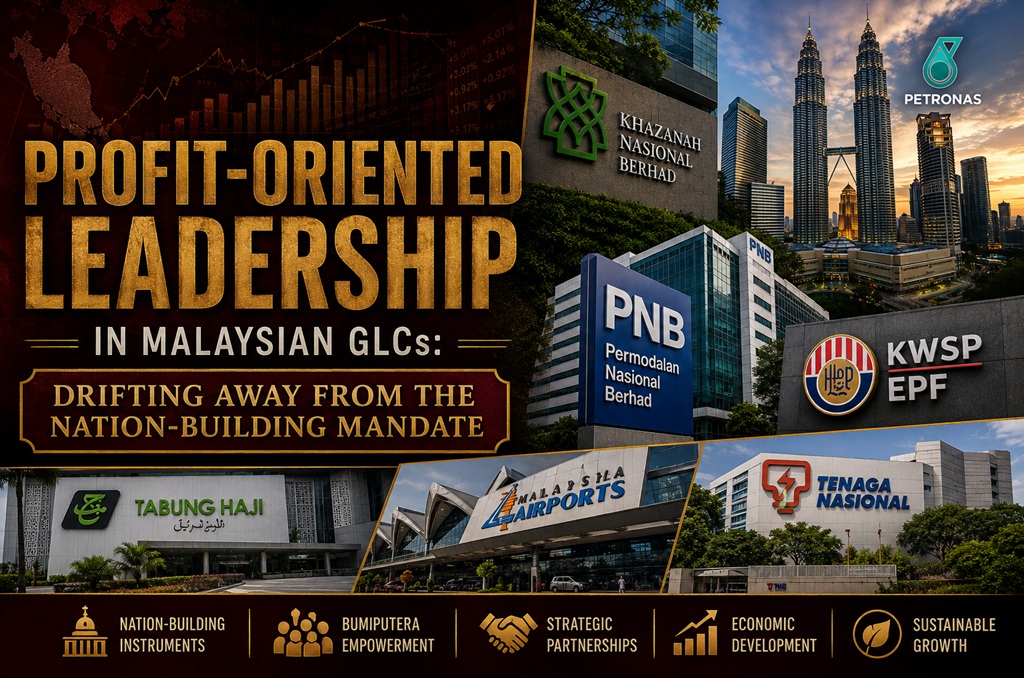
Government-Linked Companies (GLCs) in Malaysia were never intended to function purely as profit-maximising corporations. From the early years of the New Economic Policy (NEP), GLCs were established as strategic national institutions tasked with strengthening the country’s economic foundation, expanding Bumiputera participation in the corporate sector, and ensuring long-term socio-economic stability for Malaysia.
Institutions such as Khazanah Nasional Berhad, Permodalan Nasional Berhad, PETRONAS, as well as major institutional investors like Employees Provident Fund and Lembaga Tabung Haji, were expected to play a broader developmental role beyond generating financial returns. Their responsibility was to nurture Bumiputera entrepreneurship, develop local industrial capacity, create sustainable employment, and strengthen Malaysia’s long-term economic resilience.
Over the decades, GLCs became important platforms for Bumiputera vendor development programmes, strategic partnerships, financing access, industrial participation, and the creation of competitive local business ecosystems. The true success of a GLC was therefore never meant to be measured solely by annual profits, share prices, or quarterly earnings performance, but by its ability to contribute meaningfully towards national economic development and inclusive growth.
However, growing concerns have emerged over the increasing commercialisation of leadership culture within many Malaysian GLCs. In recent years, the direction of several GLCs appears to have shifted towards aggressive profit-driven corporate management, where CEOs and senior executives are evaluated primarily through short-term Key Performance Indicators (KPIs), restructuring outcomes, financial performance targets, executive bonuses, and shareholder returns.
While profitability remains necessary for corporate sustainability, excessive dependence on financial KPIs risks pushing GLCs away from their original developmental mandate. The growing corporate mindset within some GLC leadership structures increasingly mirrors private-sector profit maximisation models, where immediate financial performance often takes precedence over long-term socio-economic responsibilities.
This issue becomes particularly significant when underperforming subsidiaries or strategic business units are rapidly divested, rationalised, or sold off primarily to improve balance sheets and strengthen short-term financial indicators. Although such exercises may satisfy market expectations and improve corporate financial performance temporarily, they may simultaneously weaken Bumiputera participation in strategic industries, particularly when the affected businesses are closely linked to Bumiputera vendors, contractors, entrepreneurs, and supporting ecosystems.
The responsibility of a GLC CEO should therefore extend far beyond conventional corporate management focused purely on profitability and asset disposal. As leaders of institutions closely tied to national policy objectives, GLC executives should also be tasked with formulating sustainable turnaround strategies for struggling entities through operational restructuring, technology adoption, strategic partnerships, market expansion initiatives, institutional collaboration, and government-supported industry participation.
Unlike ordinary private corporations, Malaysian GLCs possess unique structural advantages, including access to government-linked projects, policy support mechanisms, financing capabilities, institutional networks, and strategic national collaborations. These advantages should not merely be used to maximise short-term financial recovery, but rather to rehabilitate and strengthen Bumiputera-linked business ecosystems that contribute to broader national economic participation.
The government must also reconsider the wider policy framework governing GLC leadership appointments, acquisitions, and restructuring exercises. National economic policy should not focus exclusively on stabilising corporate share prices, protecting financial statements, or appointing executives whose priorities revolve solely around KPI achievement and quarterly profitability targets.
Greater emphasis should instead be placed on preserving strategic Bumiputera-owned enterprises that contribute towards industrial development, entrepreneurial sustainability, local expertise, and long-term economic participation. Policies should encourage collaboration between GLCs and Bumiputera entrepreneurs through equity participation, strategic investments, vendor partnerships, technology transfer programmes, and market access support capable of building stronger local corporate ecosystems.
At the same time, institutional investors linked to national interests — including GLICs and government-backed funds — must also recognise their broader developmental responsibility. Their role extends beyond generating investment returns; they are also custodians of national economic objectives and socio-economic balance.
Ultimately, Malaysian GLCs must remember the fundamental purpose behind their creation. They were established not merely as profit-oriented corporations, but as instruments of nation-building, economic transformation, and socio-economic empowerment. Financial performance remains important, but it should never overshadow the larger national responsibility of strengthening Bumiputera economic resilience, preserving strategic local industries, and ensuring sustainable long-term participation in the Malaysian economy.